In the Name (+) of the Father, and of the Son, and of the Holy Ghost. Amen.
OUR FATHER
HAIL MARY
GLORY BE
V. And the Word was made flesh.
R. And dwelt among us.
O Divine Redeemer Jesus Christ, prostrate before thy crib, I believe that thou art the God of infinite majesty, even though I see thee as a helpless babe. Humbly I adore and thank thee for having so humbled thyself for my salvation as to will to be born in a stable. I thank thee for all thou didst wish to suffer for me in Bethlehem, for thy poverty and humility, for thy nakedness, tears, cold and sufferings.
Would that I could show thee that tenderness which thy Virgin Mother had toward thee, and love thee as she loved thee. Would that I could praise thee with the joy of the angels; that I could kneel before thee with the faith of Saint Joseph and the simplicity of the shepherds. Uniting myself with these first worshipers at the crib, I offer thee the homage of my heart, and I beg that thou wouldst be born spiritually in my soul.
Give me, I pray thee, the virtues of thy blessed Nativity. Fill me with that spirit of renunciation, of poverty, of humility, which prompted thee to assume the weakness of our nature, and to be born amid destitution and suffering. Grant that from this day forward I may in all things seek thy greater glory, and may enjoy that peace promised to men of good will. Who livest and reignest with the Father and the Holy Ghost, ever one God, world without end.
Sweet Babe of Bethlehem, I praise thee, I bless thee, I thank thee.
I love thee with all my heart.
I desire to worship thee.
And to be like thee in all
Thy holy and blessed ways. Amen.
O Holy Mary, as I here adore thy Divine Son, pray for all little children, that they may be protected from all harm and danger, and that they may grow in grace and in favor with God and man.
We pray thee, O Father, that the holy joy of Christmas may fill our minds with thoughts of peace, and our hearts with a sense of thy great love: hasten the time when war being done away, we may love as brethren, and bring in the reign of the Prince of Peace, Jesus Christ thy Son, Our Lord. Amen.
In the Name (+) of the Father, and of the Son, and of the Holy Ghost. Amen.
I live in a neighborhood with streets named for various characters associated with old California – Dana Way (for William G. Dana), Harte Way (for Bret Harte), Helen Way (for Helen Hunt Jackson), Murieta Way (for the famous outlaw, Joaquin Murrieta), and Joaquin Way (for Joaquin Miller, who named himself after Murrieta and preferred to spell the name with one “r”). Dig a little deeper, and we find Rosita Way (for Murrieta’s murdered wife), Carmela Way (his wife’s middle name), and Salvator Way (presumably for Salvador Mendez, the bandit who identified Murrieta’s severed head in court). These, at least, are the associations I see, although it’s possible that whoever named the streets had other people in mind. But the pattern is fairly obvious.
“The Robin Hood of El Dorado”, written by a Chicago journalist named Walter Noble Burns in 1934, seems to be the first serious effort to write a genuinely historical account of Murrieta’s life. Burns cites places, names, and dates, and claims to have obtained hundreds of oral testimonies from those who knew Murrieta or his victims – or were close to those who did. His most important historical claims seem to be specific enough to have been falsifiable in 1932 if they were, indeed, false. Consequently, I take the general outline of his narrative to be generally accurate. But Burns is no historian: there are no footnotes, and he does a lot of “filling in the blanks” that required some imagination on his part. Which makes for a rollicking good read, if a bit on the gruesome side. But the literary inventions are not what trouble me: the truth of Murrieta’s legend is unsettling on many levels, to the point of shaking one’s faith in humanity, if one ever had any.
After Joaquin Murrieta married young Rosita Feliz in Sonora, Mexico, they fled to the California gold fields and settled in a mining camp called Sawmill Flat. Murrieta was believed to have been a modest, polite, hard-working, all-around decent fellow. He was known to have built a house for his bride, to have staked a claim and done some prospecting, but mostly for “dealing monte” with an honest hand in the town’s saloon. There are no accounts of Murrieta making trouble for anyone before tragedy struck. One day a group of surly American miners came through his front door, uninvited. Amdist a flurry of racist anti-Mexican taunts, they ordered him to pack and leave town. They told him – falsely – that his claim belonged to Americans now since California had just been “sold” to the United States. Murrieta knew his rights and refused to leave. The miners proceeded to beat him unconscious. While the men were attacking Joaquin, Rosita grabbed a knife and tried to kill one of them. The miners left Joaquin for dead and turned to Rosita. After brutally taking turns with her and satisfying themselves, she finally lost consciousness, and the yankee miners left her for dead as well. Murrieta revived and called out for his wife. He found Rosita and laid her on a couch, where she also revived long enough to speak to him – and then he helplessly watched her expire.
Months later, the decaying corpses of five miners from Sawmill Flat were found in a ravine with one bullet through each of their skulls. Their bodies were too decomposed for identification, but somehow everyone knew.
After exacting justice for Rosita’s murder, Murrieta was evidently done with killing and moved on to greener pastures, settling this time in Murphy’s Diggings to be near one of his brothers. He wanted to live a quiet life. But the yankees weren’t about to leave him alone. Anti-Mexican sentiment was high in the American mining camps, some more than others, though it was by no means universal. In any case, this time Murietta was falsely accused by a belligerent miner of stealing a mule. The baffled Joaquin protested that he was borrowing his brother’s recently purchased mule. He and the miner agreed to meet, with Joaquin’s brother, in Murphy’s Diggings the next day to settle the dispute. The miner showed up with a mob of nineteen rowdy Americans, in various stages of inebriation, eager to hang a couple of Mexican thieves. Some of the more respectable Americans showed up, too, vigorously defending the Murrieta brothers and testifying to their innocence. But their protests were futile. In the end Joaquin could only watch helplessly while his brother was crudely hanged by the mob. His own life was spared, but he was flogged into a bloody pulp with thirty-nine yankee lashes on his bare back – while tied to the same tree.
This pushed Murrieta over the edge. He was forever a changed man.
In the weeks that followed, eighteen of those twenty men in the lynch mob were found dead. Their tortured bodies seemed to reveal a pattern – lassoed and dragged by a horse, rope burns around the neck, small stab wounds all over the body, and an “M” carved into the forehead. The remaining two also died violently. The instigator was shot down in the street by an American miner who witnessed the lynching and flogging and was outraged by the injustice.
The rest of the story is a flurry of criminal genius and organization, casual cruelty, and outrageously daring bravado. The idiot who wrote the back cover of my copy of the book – and who obviously didn’t read it – says that Murrieta’s campaign was all about “defending Hispanos against violence and dispossession by rampaging gold rush miners”. On the contrary: Murrieta created a vast network of loyal bandits who killed for gold, for horses, and for fun. It’s true that he had a special contempt for American miners and unleashed his vengeance on them. But it seldom had anything to do with defending Mexicans. He raided peaceful ranches that had little to do with miners or mining or Mexicans, and for some perverse reason, he targeted the most vulnerable miners in the Sierras, the hard working Chinese, who never bothered anyone and who took abuse from all directions, leaving a sea of blood and tears in his wake. Murrieta had acquired a taste for killing, discovered he was very good at it, and found that he enjoyed it. He assembled a band of outlaws known as the Five Joaquins that terrorized the state from one end to the other, though he was the undisputed leader.
Murrieta apparently had a flair for dramatic effect. He often went to town in costume, to gather information about his enemies, or just to have a good time. There are countless stories of his daring and bravado. But what endears certain criminals to the public mind – what makes folk heroes out of them – is their humanity when it shows up in kindness. We love a bad man who has a tender side and does good deeds now and then. While Murrieta avenged every treason against him, he is also said to have rewarded every kindness shown to him, no matter how small. In many of these stories he appears indifferent to the gold and loot, and gladly gives it away. If you gave him lodging and a meal without protest, he was as likely to reward you as to kill you: flip a coin. Honestly, though, from the dozens of stories recounted by Burns in this riveting book, I have to wonder how certain it could be that Joaquin Murrieta is the outlaw of every story. His gang consisted of hundreds of men and dozens of small bands with their own leaders, and there were at least four more Joaquins besides, so I have think that positive identification was not a slam dunk.
A deputized sheriff by the name of Harry Love was commissioned by the new state of California to organize the California Rangers for the purpose of stopping Murrieta and his savage partner, Three Fingered Jack. Love and his men found them in a canyon on the Coast Range, prevailed with gunfire, and for purposes of identification decapitated Murrieta and cut off the hand of Three Fingered Jack. For years these relics were displayed around the state, finally resting in San Francisco, until destroyed by the earthquake and fire of 1906. Legends of Murrieta’s buried gold persist to this day.
What is the reality of Joaquin Murrieta? The folk hero that some Hispanic or “Chicano” activists have tried to make of him is untenable. If he was ever a good man, he definitely went bad and there is no whitewashing this fact. I do think it likely that Murrieta was, at first, not a man with a criminal disposition, and that the injustices he suffered helped to propel him to a life of crime. We applaud the justice he brought to bad men when the law was absent. We are charmed by the mercy he showed, at times, when he could easily have done what by then came naturally to him. Like all criminals, and indeed all men, he was not a one dimensional personality. He was, like most of us, someone who alternated between his better and worst instincts — but his demons won in the end.
In any case, the most disturbing aspect of this book was not the terror inflicted by Murrieta’s outlaws, as awful as that was, or even the idea that a good man could turn so bad due to circumstances beyond his control, but rather the morally depraved milieu of the gold rush itself. This is not news to me, or to any student of California history. However, Burns makes it come alive in a way that caught me a little off guard. Think about it: California’s non-Indian population went from about 12,000 in 1848 to 380,000 ten years later. By some estimates the newcomers were over 90% male. So, the gold rush was an overwhelmingly male phenomenon, lacking the feminine influence that is necessary to tame and domesticate the average man. That’s already a problem. But it might not have been so much of a problem if these were average men. The ’49ers were not average men. They were, by and large, the greediest, the rowdiest, the most ignorant, the least moral, the least religious, the least educated, etc. of the men in the place from which they came. The more respectable among them still found nothing wrong with leaving wives, children, farms and businesses behind in order to undertake a dangerous journey in a fanatical quest for more wealth and riches than they could possibly use. The mining towns were essentially organized for greed and debauchery. It was not uncommon to have multiple brothels and no churches. The overall tenor of the Sierra foothills was greed, violence, debauchery, drunkenness, and very little respect for life. “Fire on the Mountain” by the Marshall Tucker Band is an accurate portrayal.
It’s true that there were good men, too, whose motives weren’t entirely debased. Many were more interested in adventure than gold. Gen. John Bidwell, the founder of Chico, comes to mind. He was well educated and made his fortune mining the Feather River. Once that was done he turned to farming and ranching, married well, treated his Indian workers well, and founded a new city. He was a deeply Christian man, and his disappointed biographers, two hard-bitten cynical journalists, declared that despite all of their research they could find no “dirt” on him to report.
I suppose that, under the circumstances, one should be surprised to find so many remnants of civilization in the mining camps. The vigilante committees are known today for their excesses and injustices, but they helped bring order to chaos, and they included many genuinely fair-minded men. Burns recounts a number of vigilante trials where the accused is acquitted and released despite popular opposition. He also reports many incidents where fair-minded men stopped, or tried to stop, intemperate vigilante “justice” in the mining camps. Although the lawlessness of the gold rush ceded to the forces of civilization, in part because the miners themselves had grown tired of it, the untamed spirit of the ’49ers remains in this state under various guises. You might say that California is still paying for its original sin.
“I am a great and sublime fool. But then I am God’s fool, and all His works must be contemplated with respect.” –Mark Twain
I read novels so rarely these days that it’s become a matter of embarrassment. A novel is hard for me to justify given the pile of books about “real” things waiting for me on my reading table. It’s not that I haven’t understood the place of great literature, intellectually, but the silent prejudice directing my personal reading habits has been this idea that a novel is an inferior device for communicating reality. (In my younger days I read some hideous novels.) It is long past time to disabuse myself of this notion: Michael O’Brien has forced me to turn the page, so to speak, which is something he is skilled at doing.
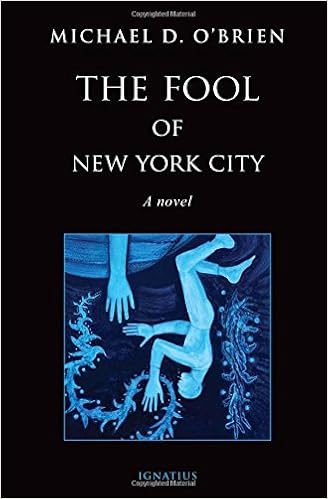
“The Fool of New York City” is a feat of the imagination. It’s not the strangest novel I have ever read, but it comes close, and the strangeness is all the more pronounced because of it’s very plausibility. “This is New York City, after all”, says one of his minor characters. O’Brien takes the reader on a gripping journey of mystery, adventure, tragedy and romance, with a knack for inserting the reader directly into the shoes of his protagonists. And who are these protagonists? The first is a giant nearly eight feet tall, a wholesome Iowa farm boy who landed in NYC on a basketball scholarship, but also a man with secrets; the second, a tormented soul he found nearly frozen in an abandoned building, an amnesiac with a cosmopolitan background and a tragic past he can’t remember. Together, they set off to discover the amnesiac’s true identity …
I can’t say much more than this without getting into spoiler territory. Read this delightful book. It’s comparatively short for an O’Brien novel, and it is infused with realities that one does well to contemplate.
I can think of no better poem for entering into the spirit of Lent than this one. The author may not approve of my mentioning his name, so I will merely link to his website.
A Sonnet to the Sorrowful Jesus
Let me mingle these, my tears, with Thine, Whose tears roll down Thy face’s cheeks so fine.
Let me share my sorrows, Lord, with Thee – And, too, Thy sorrows, prithee, share with me.
Let me know the love between us twain, Who, lovers true, do share each other’s pain.
Let compassion, common, given be; And thus shall I the love between us see.
Let me walk along, O Lord, with Thee, Along the paths of this Gethsemane;
Let me be condemned with Thee and whipped, And of the cup of sorrow take my sip;
Let me wear Thy holy crown of thorns, Along with Thee endure the soliders’…
“In my unloveliness I plunged into the lovely things which you created. You were with me, but I was not with you. Created things kept me from you; yet if they had not been in you they would not have been at all. You called, you shouted, and you broke through my deafness. You flashed, you shone, and you dispelled my blindness. You breathed your fragrance on me; I drew in breath and now I pant for you. I have tasted you, now I hunger and thirst for more.” – St. Augustine
“Christ has created you because He wanted you. I know what you feel – terrible longing with dark emptiness. And yet He is the one in love with you.” – St. Teresa of Calcutta in a letter to Malcom Muggeridge
Generally speaking, modern people choose their religion so as to conform to the lives they are living. They believe as they live, rather than live as they believe. This attempt to quiet their consciences can seem like a brave act of individual liberty in a society that glories in religious pluralism. But in a more Christian age, men did not deny the incongruity of their faith with the follies of their own lives. They knew that truth wasn’t going to change to suit them, and they forced themselves to live with the tension in the hopes that one day they would reform. Malcom Muggeridge was this pre-modern type of man. He lived badly for many years, but God refused to permit him the illusions modern men seem to enjoy.
The outline of Muggeridge’s life is well known. The son of a middle-class Fabian socialist, Malcom became impatient with the gradualism and hypocrisy of a socialist elite that didn’t have the stomach for revolution and, despite lip-service paid to egalitarianism and the plight of the working class, enjoyed lives of globe-trotting luxury and indulgence. He became a staunch communist and an open admirer of the Soviet Union. Upon graduation from Cambridge he traveled to India where he taught in the colonial schools, studied Hinduism and Islam, sympathized with Ghandi, and promoted Indian nationalism. Returning to England, he found work as a journalist and was assigned foreign correspondent to Moscow by the Manchester Guardian. He relished the opportunity to see Soviet communism up close. But what he learned in this revered “worker’s paradise” turned his enthusiasm into horror. Despite his own rhetorical excesses, Malcom discovered in himself a fierce hatred of cruelty and injustice. The barbaric inhumanity he witnessed in the name of atheistic communism turned him against every kind of mass ideological movement. He was furthermore aghast at the calculated dishonesty and, in some cases, the self-delusion of the Western intelligentsia when it came to the Soviet Union, upon which they projected their hopes and aspirations. It was also clear to him that these westerners relied upon the “success” of Marxism-Leninism for their reputations.
Malcom was the first to break the story of the Stalinist famine in the Ukraine, wherein four million perished by starvation and disease while their food – not only grain, but the food in every pantry! – was hauled away to feed more cooperative Russians. Those who resisted, or who were suspected of resistance, were simply shot. To keep the word from getting out, the border was sealed so that Ukrainians had no escape. On a clandestine and unauthorized trip to the Ukraine, Malcom watched starving peasants being loaded onto cattle trucks at gunpoint with their hands bound behind their backs. The story was censored at first, but Malcom would not be silent and became an implacable foe of communism for the rest of his life.
This courageous but unpopular act nearly cost Malcom his career. Still a man of the political Left, by this time the Left would no longer have him. He was barely employable as a journalist in England in all but the most pro-establishment Tory publications (which he detested politically) and gossip columns. His family struggled as he tried to pay the bills with various desperate writing gigs. The war came and he joined the armed forces as an intelligence officer, serving honorably. He returned to England and, by a series of unlikely employments and promotions, ended up a media star himself, landing finally at the BBC. During this time his politics moved further away from those of any party and developed into something that resembled a pragmatic libertarianism. He was clearly a gifted wordsmith, a master of the language, and an incisive commentator. The quality of his writing was recognized as superb. He was surprisingly adaptable as a compelling television presence. Malcom became widely respected – and also reviled – for his piercing criticism of those in positions of power and authority. His transparent sincerity was part of his appeal, once admitting “I hate government. I hate power. I think that man’s existence, insofar as he achieves anything, is to resist power, to minimize power, to devise systems of society in which power is the least exerted.” Toward the end of his career his wit, humor, and voice were known to all Englishman. His highly televised face was recognized everywhere.
And yet, beneath all of this worldly success, Malcom had long been miserable.
Malcom read the Bible secretly as a child, enthralled with the Christ-figure. While at Cambridge he embraced the religious skepticism of the day, but found himself drawn to mystics and even to the devout. His best friend was a serious Christian who became an Anglican clergyman. Malcom especially admired his asceticism and religious discipline. At the same time Malcom had fallen into the casual homosexuality of the elite, a phenomenon that was rife in England at the time, though he was still in love with a girl back home. (The extent to which casual male homosexuality was a staple of upper class English life has always eluded me, but it seems to have been ubiquitous for several generations even as it remained illegal. This must have had severe psychological effects on many of its practitioners.) His passions became unruly, particularly his sexual passions. When he married Kitty Dobbs, as good Fabian socialists they seriously considered having an “open marriage”. It might as well have been. Malcom’s sordid infidelities are too numerous to count; Kitty’s are less numerous but no less tragic. This compulsive behavior went on for decades, all through the highs and lows of his career. It always left him feeling empty, despairing, and lost. He and Kitty fought bitterly and constantly. As his family grew, he sought escape in projects that took him far from home. He attempted suicide at least once. He agonized over religious questions, and though he couldn’t bring himself to believe, he couldn’t bring himself to reject God altogether either.
Part of Malcom’s inner torment was his self-image as a permanent outsider. Painful in his youth, he tried hard to belong without success. Later he came to see his outsider status as having important advantages. He was in that sense a free man. As a writer he could say what he wanted to say, without worrying about who it might offend. He relished attacking the “establishment” and its acolytes, but extended his range of targets to anyone whom he felt exercised undue influence over others. Maintaining this posture required a spirit that lacked generosity. He was outside by choice now, and developed a sort of contempt for insiders. This gave him his freedom. Insiders are not free: they have to bow to their institutions and defend their absurdities. Or so Malcom thought. As applied to the Church, Malcom could not see himself accepting a set of doctrines that were above criticism or deferring to churchmen who were, in his estimation, just party men like all the others. The extreme patriotism after the war ended turned him off for similar reasons. You would never find Malcom Muggeridge waving a flag or a pom-pom. But his independence came at the price of arrogance, to the point where, after his acceptance of the Christian faith, he could no longer stand to watch himself on television, deploring this “terrible man” with a “certain arrogance about myself” and “completely lacking in humility”.
Malcom’s exceptional intelligence, energy, and productivity was driven by a force he didn’t understand. The sheer volume impresses – books, plays, documentaries, interviews, hundreds of articles. He interviewed everyone from Churchill to MacArthur to Stalin’s daughter. His literary circles included all the men of letters of his time, being closest to George Orwell. He described his friend Graham Greene as a “saint who is trying unsuccessfully to be a sinner”; Hilaire Belloc as “not at all a serene man” nursing decades old grievances, and of whom, “having written about religion all of his life, there seemed to be very little in him”; and of Evelyn Waugh he said “I have formed the impression that he does not like me”, which was evidently true, although in fairness Waugh was a misanthrope who didn’t like anybody. Apart from Chesterton, whom he admired, the English Catholic literati did not impress Malcom as men whose Catholicism had changed them for the better. They left him curious but uninspired.
Behind the scenes of this busy public life was a titanic internal struggle between the flesh and the spirit. Even as Malcom gave in to the flesh, he would not surrender his mind. He began to see with increasing clarity how the ethos of liberalism had poisoned his own life, making himself and his loved ones miserable. What was previously a slow awakening became a torrent of awareness. He decried the comfortable materialism of his circumstances and longed for poverty and asceticism, for “the simple life”. He saw the rise of sexual promiscuity (with the implied dismissal of marriage), contraception, abortion, and euthanasia as signs of a decaying civilization with a Freudian death wish. He understood that the decline of Christian faith and respect for the Church was the source of these evils. He professed these insights publicly even as he continued to live according to his old habits.
Malcom plunged himself into research about this Jesus, this Man who haunted him all of his life and wouldn’t leave him any peace. The painful alienation and longing for God expressed in St. Augustine’s “Confessions” resonated with him acutely. He recalled with amazement the serene faith of the peasants he encountered in churches behind the iron curtain. He traveled to Lourdes and Palestine and was inspired by the faith of the Christian pilgrims, mostly of humble origins. He befriended a holy priest who ministered to the severely disabled. Finally, he sought out Mother Teresa, bewildered at this woman who accomplished so much with so little, who didn’t shrink from loving the unlovable, or touching the untouchable, and not for an idea or a set of abstract social principles, but for the love of a Person. The publicity-shy nun permitted him to make a television documentary about the works of her Missionaries of Charity, and to write a book about her – “Something Beautiful for God” – bringing her then obscure work to the attention of the world. Still unable to grasp Christ directly, Malcom was permitted to see Him through the life of a genuine saint, and in the faces of the world’s forgotten ones.
And then, in the twilight of his life, the old familiar pain of being an outsider looking in returned to him. He wanted what these Christians had, Who these Christians had, but didn’t know how to possess Him. He wanted to be counted among them, but still couldn’t bend the knee.
Malcom spent the remainder of his career defending and promoting a Christian worldview at every opportunity. Yet he remained apart. Malcom’s difficulties with the Catholic Church were a surprising combination of two things: 1) He was shocked and disappointed at the changes in the Church that seemed to have resulted from the Second Vatican Council. He saw religious life collapsing everywhere and moral teachings abandoned. 2) He was still a theological skeptic himself. Despite the post-conciliar liberalism that had no regard for doctrine, he was an honest man and would not join the Church if he didn’t accept its dogma. It’s not clear that he connected theological orthodoxy or liturgy with the moral precepts that concerned him. Nor is it clear that he worked very hard at theological understanding. This biographer suggests that Malcom was bored by theology. Although a reluctant moralist, he was fundamentally a poetic soul who seemed content with a mystical approach to the person of Jesus Christ.
Despite his distance from the Church, he began to call himself a Christian and tried to live like one. He established a daily prayer regimen. He gave up his womanizing, and further still, his drinking and smoking. He ate sparsely and became a vegetarian. He repaired his marriage to Kitty and tried to make things up to her. Their marriage became something beautiful and attractive, a hard-won prize. Their final years were spent in love, enjoying one another’s company and the company of friends, often reading the Pslams aloud to each other. Kitty would later write: “It is inevitable that in the course of time trouble and strife between man and wife should occur. This is for the most part due to our human vanity and egotism; but these differences can be overcome, and every reconciliation strengthens the bond of love.”
At long last, Malcom and Kitty received a letter from a respected priest and friend. In between formalities, the letter contained only one substantive line: “It is time.” Now 79 and 78 years old, respectively, this was all they needed. Malcom and Kitty Muggeridge formally entered the Catholic Church in November of 1982, finally at home and at peace. In July of 1990, Malcom suffered a crippling stroke. The state of his soul as a Christian penitent is manifest in the words he shouted that first night in the hospital: “Father, forgive me! Father, forgive me!” He died from complications four months later.
My oldest son is a graduate of Thomas Aquinas College, a “great books” school that rejects textbooks and lectures. Students read only the great books themselves, and the classroom utilizes the discussion method. The professors, who are called “tutors”, are present only to facilitate the discussion and keep it on track. Furthermore – and this surprised me at first – the college discourages reading outside sources as class preparation. The idea is that one is supposed to grapple with the text itself, not someone else’s interpretation of the text. Students are trained to ask “what does the text say?” and “what does the author mean?” without prejudice.
When I first attended one of their junior classes as a parent-guest, I found myself extremely impatient with the discussion. I had the answers, or so I thought, and wondered why the students would spend so much time on a single sentence when the meaning was obvious to me.
I have since been humbled. The meaning was only “obvious” to me because of the prejudices in my head derived from other sources and my own rash judgments. These students, by their junior year, were mastering the discipline of putting all of that aside for the sake of authentic understanding. What does the text say? What doesn’t it say? What can we learn from the context? What is the author’s perspective? How do we really know? Furthermore they were forced to listen to each other, to be challenged and corrected, and sometimes embarrassed by their own mistakes. By their junior year these young scholars were thinking clearly and methodically, choosing their words very carefully, and best of all, in true Thomistic fashion, interpreting each other’s words in the most reasonable sense possible. It was a beautiful sight to behold.
The objective nullity of some putative marriages is a reality. You can’t marry your sister. You can’t kidnap a woman and force her to wed. You can’t marry under a false pretext – e.g., pretending to be single when you’re married to someone else. You need to be sober when saying your vows. Etc.
Nevertheless, annulments should be difficult, time-consuming, and expensive to obtain.
A healthy culture of marriage demands that Church and State assume the validity of all publicly celebrated marriages. That is the wisdom behind the “presumption of validity” that the Church has always maintained toward every civil marriage, even marriages that are purely natural and non-sacramental. A culture of marriage, protected by marital indissolubility and the presumption of validity, is necessary for the protection of children, the most innocent and helpless among us. The procreation and education of children is the primary purpose of marriage. That is to say: it is greater than the secondary purpose of marriage, which is the union and mutual help of the spouses. Therefore, it makes sense that the Church and human society arrange things in such a way that protects children from parental abandonment and the burden of illegitimacy.
All marriages are subject to difficulties, conflicts, trials, and crises of various kinds. That’s why the vows say “for better, for worse, for richer, for poorer, in sickness and in health, until death do us part”. Everything is covered, even the very worst. A valid sacramental marriage cannot be dissolved for any reason whatsoever, no matter what the future may hold. It is absolutely essential, psychologically, that divorce and/or annulment never be considered an option in the minds of married people. When you say the vows, you accept every possible danger the future may bring – period.
Why is this so important? Because for most people, the married state is their means of salvation. The salvation of souls depends upon spouses enduring and persevering through the trials and tribulations of marriage. The Christian experience proves that marriages can survive their difficulties if spouses will only persevere in charity. But if one or both spouses has one eye on the annulment door, there is little incentive to persevere. It is just too easy to throw in the towel, and many do. The new “presumption of invalidity” for troubled marriages – reigning now for 40+ years and brought to a climax by the devastating motu proprio of Pope Francis – has become a classic “self-fulfilling prophecy”, achieving that which it assumes.
If the Church has failed to catechize marriage properly, the response should be a restoration of orthodox catechesis, not the normalization of of fast, cheap, drive-through annulments. In the eyes of the faithful, let the presumption of marital validity stand. Unfortunately there can be no presumption of validity for contemporary annulments.
God is merciful. Behold the third delusion of sinners by which an immense number are lost! A learned author says, that the mercy of God sends more souls to hell than his justice; for sinners are induced, by a rash confidence in the divine mercy, to continue in sin and thus are lost. God is merciful. Who denies it? But great as is his mercy, how many does he send to hell every day ? God is merciful: but he is also just; and therefore he is obliged to punish those who offend him. He shows mercy; but to whom? To them who fear him. He hath strengthened His mercy toward them that fear Him. As a father hath compassion on his children, so hath the Lord compassion on them that fear Him (Ps. cii, 11, 13). But he executes justice on those who despise him, and abuse his mercy to insult him the more.
God pardons sin; but he cannot pardon the will or the determination to sin. St Augustine says, that he who sins with the intention of afterward repenting, is not a penitent, but a mocker of God’s majesty. But the Apostle tells as that God does not allow himself to be mocked. Be not deceived. God is not mocked (Gal. vi, 7). It would be a mockery of God to insult him as often and as much as you please, and afterward to expect heaven. But as God has shown me to many mercies hitherto, so I hope he will treat me with mercy hereafter. Behold the fourth delusion ! Then, must the Lord, because he has had compassion on you, show mercy forever, and never chastise you ? No: the greater have been his mercies to you, the more you have reason to fear that, if you offend him again, he will pardon you no more, but will take vengeance on your sins.
Say not: I have sinned, and what harm hath befallen me? For the Most High is a patient rewarder (Ecclus. v, 4). Say not: I have sinned, and have not been punished; for though God endures, he will not do so, forever. When, the number of mercies which he has resolved to show to the sinner is exhausted, he then punishes all his sins together. And the longer God has waited for his repentance, the more severe will be his punishment, says St. Gregory. (In Evang. Hom. 13). If then, O my brother, you see that you have, often offended God, and that he has not sent you to hell you should say; The mercies of the Lord that we are not consumed (Lam. iii, 22). Lord ! I thank Thee, for not having sent me to hell, as I deserved. Consider how many have been damned for fewer sins than you have committed, and labor to atone, by penance and other good works, for the offences you have offered to God. The patience which he has had with you, and the great mercies which he has shown to you, and not to others, ought to animate you not to offend him again, but to serve and love him.
Blessed John Henry Newman – like many nuanced and complex thinkers – has the unhappy burden of being misunderstood by just about everybody. He dedicated his life to fighting against liberalism in religion, becoming one of its most formidable enemies. His effectiveness was undoubtedly due, in part, not only to his powers of persuasion, but also to the example he presented as a powerful intellect and evidently liberal (in the classic sense meaning “free”) personality devoting itself to the service of … dogma. Catholic dogma! If Newman is for it, there must be something to it! Nevertheless he was also intellectually satisfying and persuasive, assisting the conversions of multitudes to the eternal Catholic Faith. These days, however, one often finds Newman disingenuously adopted by the very same liberals who Newman would have eaten for breakfast if he had the opportunity. I have long wondered how most of the nation’s heterodox “Newman Centers” on university campuses get away with the name. The only possible explanation is that they know nothing about Newman’s work beyond, perhaps, a rude caricature of his theory of conscience.
At the same time there have always been a number of Catholics who have suspected and even accused Newman of the very liberalism he condemned. And to be honest, his critics aren’t entirely wrong. Newman breathed the cultural air of Oxford liberalism for much of his life: these were the people he was arguing with, these were the minds he had to convince, and it seems clear that he adopted some of their premises for the sake of common ground. We should expect that he shared much of this common ground even without consciously embracing it. But I have to maintain that Newman’s liberalism – yes, the term is fair if used in context – was largely a matter of temperament and process, not religion, and though it did lead to mistakes in my opinion, on balance it did not pose a threat to the integral Catholic faith he professed and defended. On the contrary, Newman’s thought opened the doors to a perfectly legitimate investigative approach to Catholicism that most intellectuals felt was heretofore closed to them. Would that all Catholics were as “liberal” as Newman!
But don’t take my word for it. As the result of a brief discussion with a friend this afternoon, I found online a letter from Pope St. Pius X himself defending Newman against his critics – a rebuke not only to traditionalists who revere Pope St. Pius X and revile Newman, but also to certain liberals for whom Newman is the hero and Pius X the villain. I reproduce the letter here in its entirety.
LETTER
In which Pope Pius X approves the work of the Bishop of Limerick on the writings of Cardinal Newman.
To his Venerable Brother Edward Thomas Bishop of Limerick
Venerable Brother, greetings and Our Apostolic blessing. We hereby inform you that your essay, in which you show that the writings of Cardinal Newman, far from being in disagreement with Our Encyclical Letter Pascendi, are very much in harmony with it, has been emphatically approved by Us: for you could not have better served both the truth and the dignity of man.
It is clear that those people whose errors We have condemned in that Document had decided among themselves to produce something of their own invention with which to seek the commendation of a distinguished person. And so they everywhere assert with confidence that they have taken these things from the very source and summit of authority, and that therefore We cannot censure their teachings, but rather that We had even previously gone so far as to condemn what such a great author had taught.
Incredible though it may appear, although it is not always realised, there are to be found those who are so puffed up with pride that it is enough to overwhelm the mind, and who are convinced that they are Catholics and pass themselves off as such, while in matters concerning the inner discipline of religion they prefer the authority of their own private teaching to the pre-eminent authority of the Magisterium of the Apostolic See. Not only do you fully demonstrate their obstinacy but you also show clearly their deceitfulness.
For, if in the things he had written before his profession of the Catholic faith one can justly detect something which may have a kind of similarity with certain Modernist formulas, you are correct in saying that this is not relevant to his later works. Moreover, as far as that matter is concerned, his way of thinking has been expressed in very different ways, both in the spoken word and in his published writings, and the author himself, on his admission into the Catholic Church, forwarded all his writings to the authority of the same Church so that any corrections might be made, if judged appropriate.
Regarding the large number of books of great importance and influence which he wrote as a Catholic, it is hardly necessary to exonerate them from any connection with this present heresy. And indeed, in the domain of England, it is common knowledge that Henry Newman pleaded the cause of the Catholic faith in his prolific literary output so effectively that his work was both highly beneficial to its citizens and greatly appreciated by Our Predecessors: and so he is held worthy of office whom Leo XIII, undoubtedly a shrewd judge of men and affairs, appointed Cardinal; indeed he was very highly regarded by him at every stage of his career, and deservedly so.
Truly, there is something about such a large quantity of work and his long hours of labour lasting far into the night that seems foreign to the usual way of theologians: nothing can be found to bring any suspicion about his faith. You correctly state that it is entirely to be expected that where no new signs of heresy were apparent he has perhaps used an off-guard manner of speaking to some people in certain places, but that what the Modernists do is to falsely and deceitfully take those words out of the whole context of what he meant to say and twist them to suit their own meaning.
We therefore congratulate you for having, through your knowledge of all his writings, brilliantly vindicated the memory of this eminently upright and wise man from injustice: and also for having, to the best of your ability, brought your influence to bear among your fellow-countrymen, but particularly among the English people, so that those who were accustomed to abusing his name and deceiving the ignorant should henceforth cease doing so.
Would that they should follow Newman the author faithfully by studying his books without, to be sure, being addicted to their own prejudices, and let them not with wicked cunning conjure anything up from them or declare that their own opinions are confirmed in them; but instead let them understand his pure and whole principles, his lessons and inspiration which they contain. They will learn many excellent things from such a great teacher: in the first place, to regard the Magisterium of the Church as sacred, to defend the doctrine handed down inviolately by the Fathers and, what is of highest importance to the safeguarding of Catholic truth, to follow and obey the Successor of St. Peter with the greatest faith.
To you, therefore, Venerable Brother, and to your clergy and people, We give Our heartfelt thanks for having taken the trouble to help Us in Our reduced circumstances by sending your communal gift of financial aid: and in order to gain for you all, but first and foremost for yourself, the gifts of God’s goodness, and as a testimony of Our benevolence, We affectionately bestow Our Apostolic blessing.
Given in Rome at St. Peter’s, on 10 March 1908, in the fifth year of Our Pontificate. Pius PP. X
Illegal immigration is one of those topics that tends to divide the best kinds of Catholics. The public statements of the hierarchy seem to be absolutist in nature and to that extent wholly unreasonable. Likewise, political voices on either side of the debate tend towards an off-putting rhetorical excess. The “left” tends to dismiss the legitimate considerations of the state in securing the border, and to ignore the economic and social costs of the problem. The “right” tends to ignore the human consequences of any proposed solution, while failing to make necessary distinctions between different kinds of illegal immigrants. It seems to me that any reasonable policy solution must consider the following realities:
1. All nations have the right – and the duty – to control their borders.
2. The best interests of its own citizens is any government’s primary concern.
3. Nevertheless, a nation may also have moral obligations to non-citizens both inside and outside its own borders. Those obligations vary according to circumstances.
4. The United States has tacitly encouraged and even rewarded illegal immigration for decades. Millions have come here illegally and made their homes with this understanding. It’s much like the speed limit: in many places governments have a statutory limit on the books, but actually enforce something else as a matter of unwritten policy. The difference is that, in the case of illegal immigration, the violators have actually been rewarded by the government. The reality of this situation sharply mitigates – but does not eliminate – the culpability of illegal immigrants.
5. In justice, then, mass deportation of all illegal immigrants is off the table. Such a solution would be a human catastrophe and a punishment that is disproportionate to the offense.
6. At the same time, rewarding illegal immigrants with citizenship and other benefits is also off the table. Such a solution would breed further contempt for the law, and would be an injustice to those who came about their citizenship honestly.
I believe there is a sensible way to make the best of a bad situation. First, deport illegal immigrants who have shown themselves to be otherwise lawless by their involvement with gangs, drugs, violence, etc. That’s a slam-dunk. Second, allow the rest to apply for a special class of permanent legal residency with the help of a citizen sponsor (e.g., an employer or relative). Permanent legal residency is not citizenship. This particular class would exclude the right to vote, and would also exclude the right to certain non-essential public services (e.g., higher education subsidies). Third, announce that within 180 days our immigration laws will be strictly enforced, and then enforce them. Finally, immigration policy should take into account certain emergencies that may arise, such as the unaccompanied children now flooding into the country. They should be well-treated but with the goal of repatriation or, perhaps, adoption by qualified American families.
One can anticipate the objections from both the right and the left. Many on the right will argue that my suggestion is too soft and continues to reward lawbreakers. My reply is that many of these illegal immigrants were acting on the basis of what they understood to be the unwritten policy of the American government. The United States bears significant responsibility for the lives of those affected by decades of “don’t ask, don’t tell” immigration policy. Many on the left will argue that my suggestion creates “second class citizens” without certain rights. I reply that we already have “second class citizenship” written into the law for various kinds of people who are denied the rights of full citizenship – foreign students, children, convicted felons, etc. Those who enter this country illegally, even if their culpability is mitigated, ought to face a penalty of some kind. Inequality is a fact of life and the law needs to accommodate reality.







 New Sherwood